Think and prove at the pace you build.
AI has solved the problem of how fast developers can build. The urgent problem now is for teams to think about what is worth building and prove that it works at the same pace.
 BETA
Get started +
BETA
Get started +
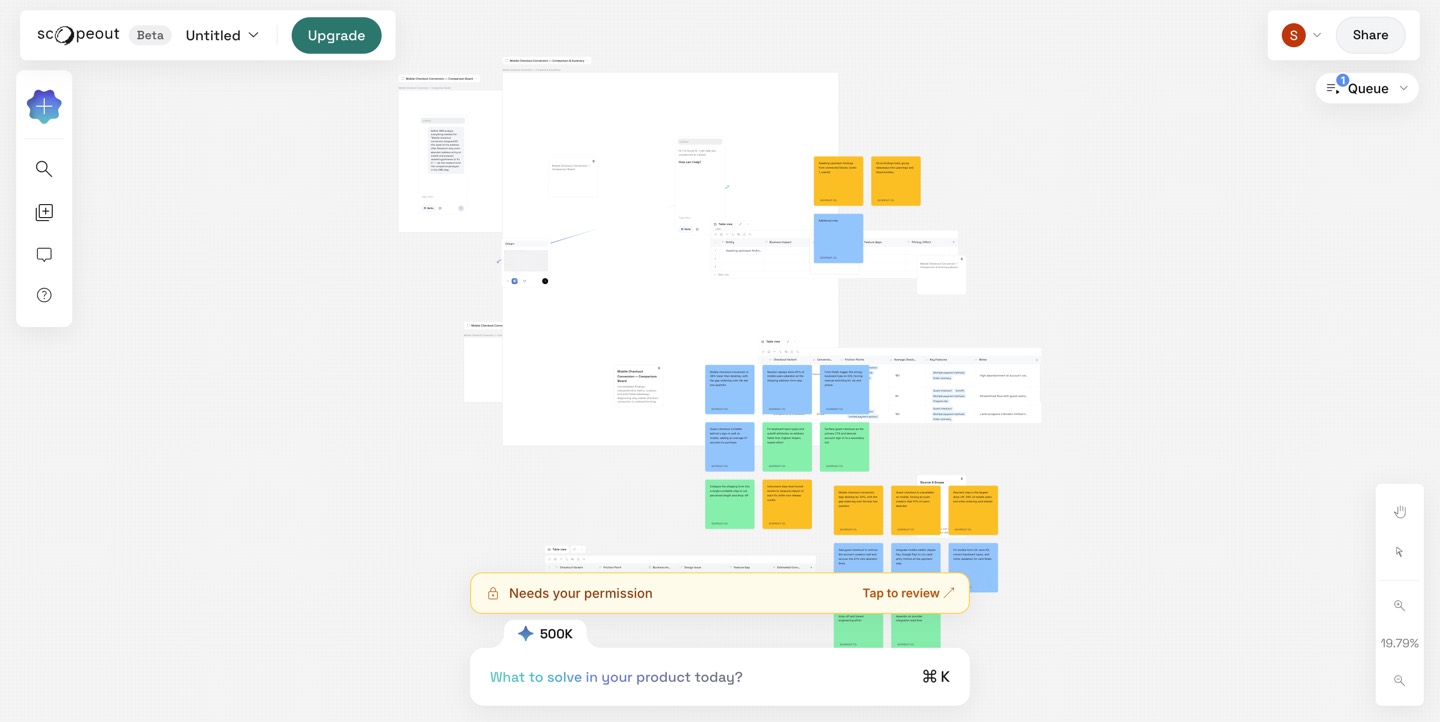
The control center for a digital product led business. One canvas where your team and AI operators research, analyze, design, build, test, monitor and improve, together.
By Scopeout
Control center for digital product led businesses
The problem
AI made us faster at shipping. It didn't make us faster at knowing what to ship for better results.
The arc
Three eras of building products, each shorter than the last. AI has solved how fast developers can build; the urgent problem now is for teams to think about what is worth building and prove that it works at the same pace. Scopeout is the bridge from the second era to the third.
Research in one tool, designs in another, tickets in a third, numbers in a fourth, the decision in a chat thread. Six weeks from question to fix, and nobody checks if it worked.
Add saved addresses to mobile checkout.
One prompt: code, tests, preview, live in an afternoon. But which sentence to type is still a guess, made alone, with the reasoning lost.
Scopeout continuously optimizes your product, spinning up new onboarding, pricing, flow, layout, and copy variants and running them as live A/B tests against real traffic. Winners get promoted, losers get retired, and the next round of variants is already in flight. Your product gets sharper every week, on its own.
What the control center runs
The loop every product team already runs, made operable: Research, Analyze, Design, Build, Test, Monitor, Improve. Pick a bucket. See the prompt, what the canvas ran, and the artifact it produced, plus the teammate who directed it. Screens marked "real run" are unedited captures from Scopeout on 14 Sep 2026.
It gathers your evidence
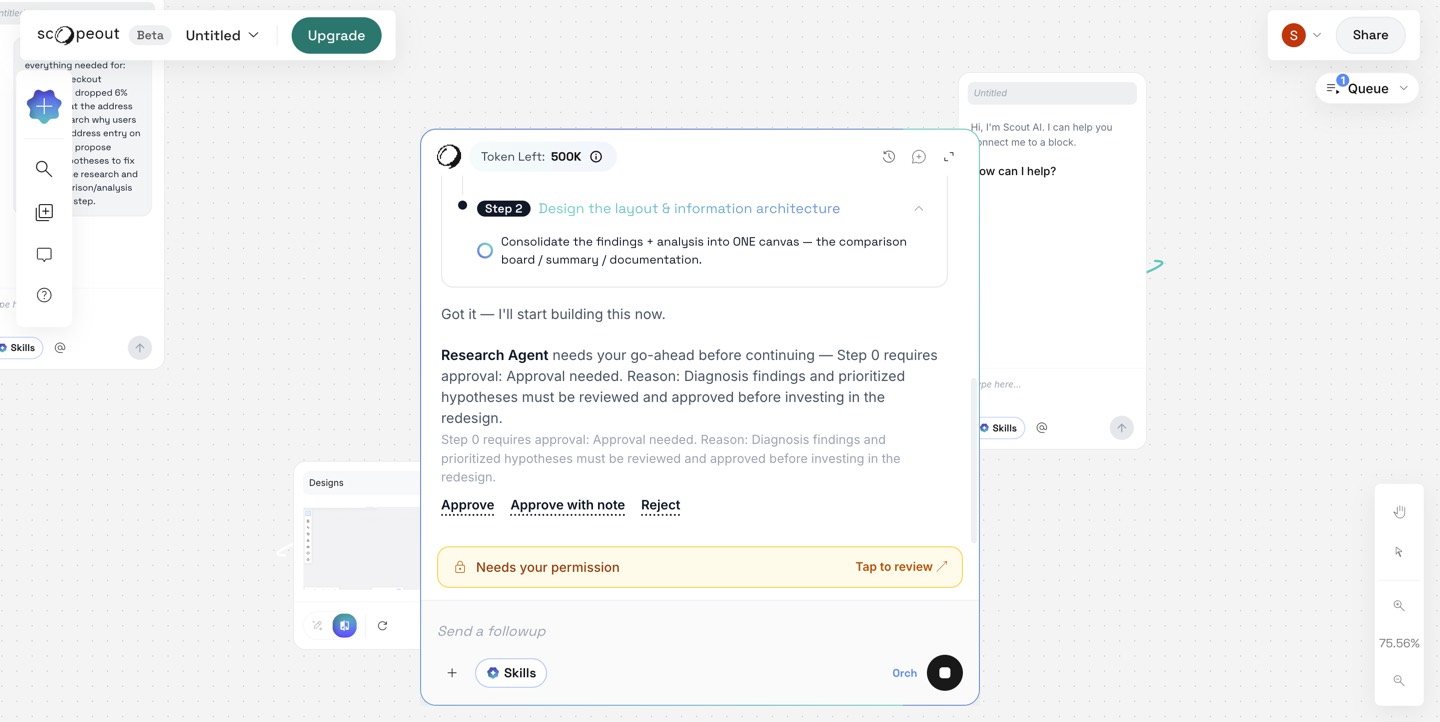
Type the problem. The canvas proposes the steps, asks for data it does not have, and stops for your go-ahead before spending a token. Then Research reads replays, tickets, reviews, transcripts and competitor flows, and returns a cited brief.
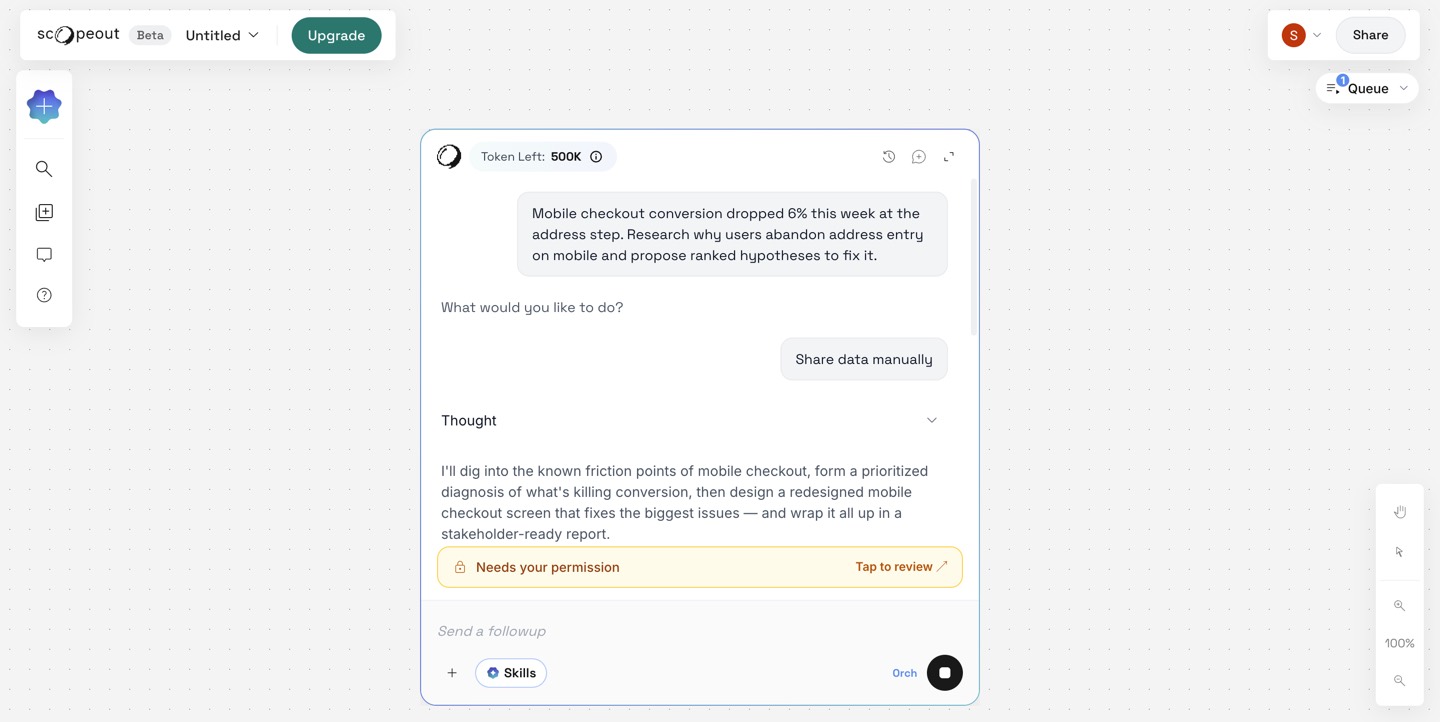 Real run · plan + permission gate
It turns evidence into decisions
Analyze consolidates what Research found into boards: findings in blue, fixes in green, priorities in yellow, plus a comparison table. Hypotheses are ranked by impact, confidence and effort. The Research Agent stops for approval before anything is designed.
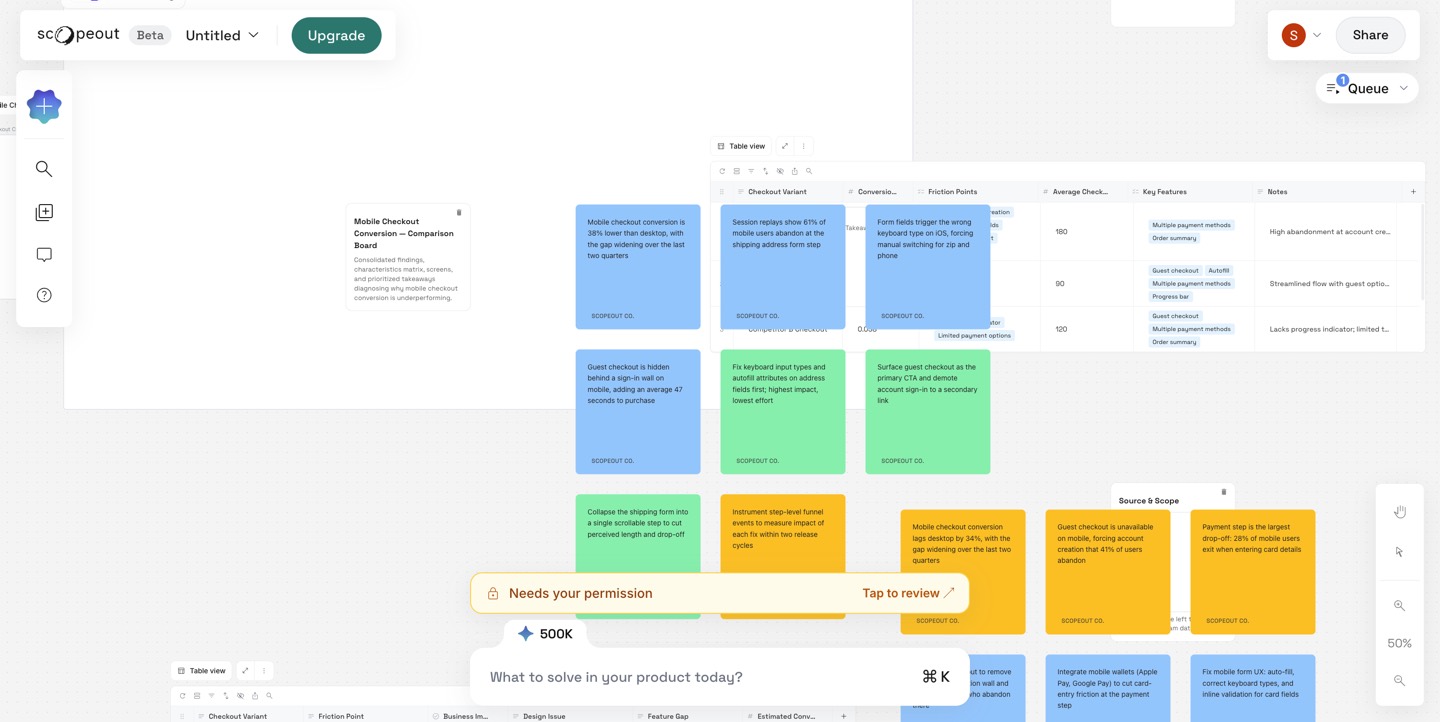 Real run · consolidated findings
It designs in your system
Give it the spec, a screenshot or a sentence. Design builds the screen from your imported design system: here, a delivery address step with progress, Apple Pay shortcut, saved addresses first and a single-line address field. The designer picks and refines inline.
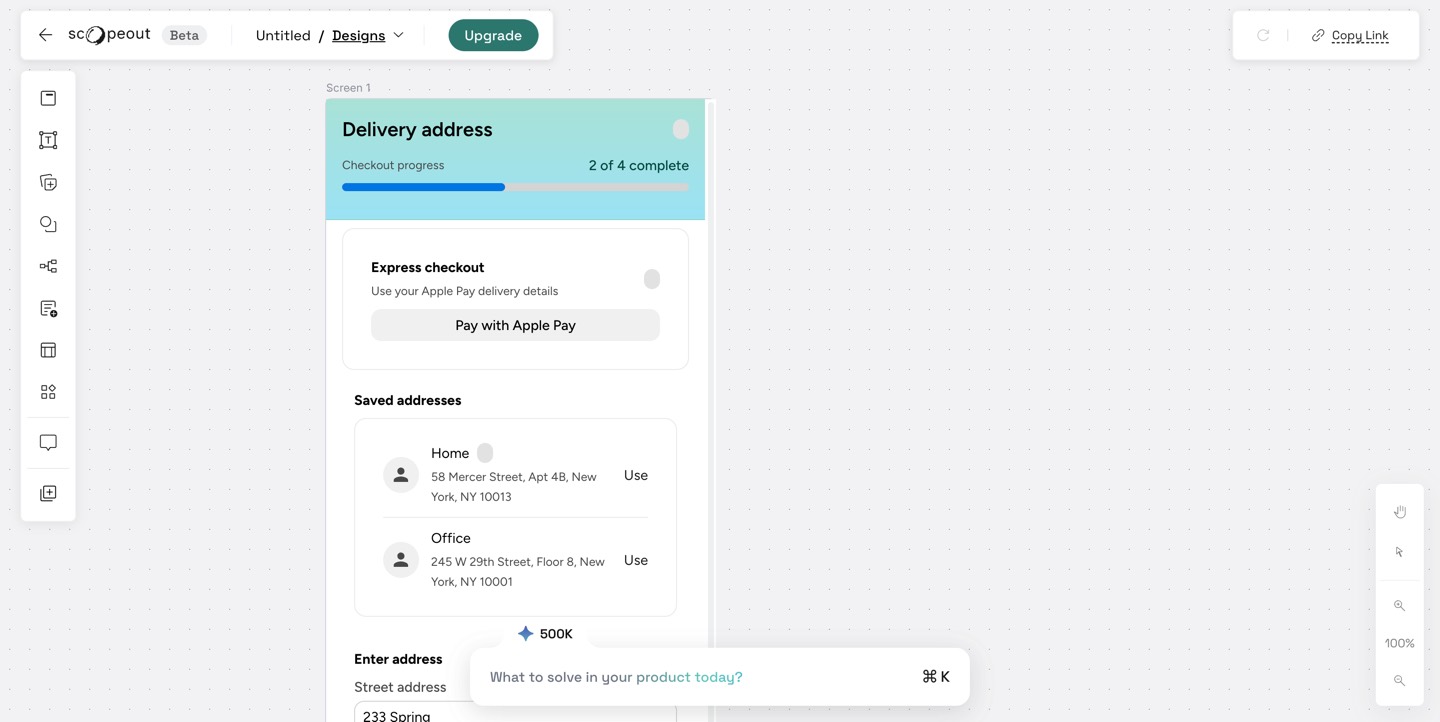 Real run · generated from the design system
It ships in your codebase
Connected to your repo and design system, Build turns the chosen variant into working code behind a flag, writes the tests, deploys a preview and opens the PR. Engineers review code that already matches the spec and the evidence.
AddressStep.tsx        +131 −62
useAddressLookup.ts    +58
checkout.spec.ts       +25 −26
tests: 12 pass   flag: address_v2
It proves the change
Test runs the variants, computes lift with sequential stopping rules, holds guardrails on refunds, support and latency, and promotes the winner only when it clears the bar you set. Every result is written back as evidence for the next run.
It watches your product
Every funnel step, segment and release compared against its own baseline. When a metric moves, Monitor isolates where, for whom and since when, then queues the problem for Research with an owner, instead of waiting for Monday.
It makes the next run smarter
Each run writes its own record: problem, evidence, decision, who approved, outcome. Results feed the outcome library and your playbooks, so the next hypothesis starts from what worked. Leadership reads the log; nobody writes the update.
Anatomy of a run
Steps 1 to 3 are what Scopeout actually did on 14 Sep when we typed this sentence; the capture is unedited. Steps 4 to 6 are the intended flow once Build and Test are wired to your repo and flags.
“Mobile checkout conversion dropped 6% this week. Find out why and fix it.”
Address entry, iOS Safari, since release 4.12.0. Desktop and Android unaffected.
142 sessions, 38 tickets, 27 reviews; the browser agent fails autofill 4 of 5 times on the real checkout.
Boards with blue findings, green fixes and yellow priorities, a comparison table, and ranked hypotheses. The Research Agent stops: "Diagnosis findings and prioritized hypotheses must be reviewed and approved before investing in the redesign."
Built from your components; frames sized to content.
PR #2231, +214 −88, 12 tests pass, preview deployed on address_v2.
Sequential A/B with guardrails; the whole run logged for the week-37 growth review.
No research deck. No spreadsheet export. No status meeting. The growth lead typed one sentence, three teammates approved in place, and the record wrote itself.
Open this run on the canvas→The same canvas, in seven buckets at once
Each bucket below is a real area of the canvas. Buckets marked "real run" show unedited captures from 14 Sep 2026; "concept" marks what is designed but not yet wired. Nothing ships as a separate tool your team has to adopt, and every bucket has a person who directs it.
Real run · 14 Sep 2026Ask a question in a sentence or drop a screenshot. The canvas plans the work, asks for the data it does not have, and waits for your go-ahead. Then replays, tickets, reviews, interviews and competitor teardowns become a cited brief on the canvas.
Real run · 14 Sep 2026Findings, fixes and priorities land on boards the whole team can see. Hypotheses are ranked by impact, confidence and effort; the spec and acceptance criteria link back to the evidence. Approval happens on the block, not in a meeting.
Real run · 14 Sep 2026Generate flows and screens from your design system: Figma, Storybook or code. Give it a screenshot and get on-system variants, side by side. Edit inline; the designer keeps the pen.
AddressStep.tsx      +131 −62
useAddressLookup.ts  +58
checkout.spec.ts     +25 −26
tests 12 pass · preview address_v2
The canvas reads and edits your actual codebase. Prototype, tests, preview, pull request, behind a flag and linked to the spec and the evidence. Engineers review; nothing ships without them.
A/B/n tests with sequential stopping rules and guardrail metrics. Winners promote automatically once they clear the bar you set; results write back to the canvas as evidence for the next run.
Every funnel step, segment and release watched against its own baseline, deterministically, around the clock. When something moves, Monitor isolates where, for whom and since when, then queues the problem for Research with an owner.
Every run writes its own record: problem, evidence, decision, who approved, outcome. Outcomes feed the playbooks, so the next hypothesis starts from what worked. Leadership reads the log in Notion, Confluence or Slack; nobody writes the update.
Collaborative by default
One canvas, the whole company on it. Product, Design, Growth, CX, Engineering, and leadership work on the same blocks, see the same evidence, and approve in place. No exports, no status decks.
Your product, customers, brand, design system, codebase, and past decisions live on the canvas a single time. Every operator and every teammate works from the same memory.
Decide who directs each part: the PM approves hypotheses, the designer picks variants, the engineer merges, growth promotes winners. Autonomy is a dial, per part, per team.
When Research hands to Product, or Design hands to Build, the evidence and the reasoning travel with the block. Comments, mentions, live cursors. Nothing is re-explained in a meeting.
What's next
Once a product has traction, the same canvas that built the fix starts looking for what to improve, on its own. It finds the growth leaks, writes the hypothesis, runs the test, ships the winner. You watch the numbers move.
Funnels, anomalies, friction scoring, segment discovery, release correlation. All deterministic, all running 24 / 7. Causal-inference and significance guards built in so the canvas only acts on real leaks, not noise.
The engine produces a ranked queue of structured signals. The model sits at the very end as a synthesizer, pulling replays, reviews, tickets, and your team's notes, and writes a human-readable hypothesis with proposed test, expected lift, and confidence.
A growing library of your past outcomes, proven methods, and your team's expertise feeds the synthesizer, so winning patterns on one part of the product accelerate the next. Benchmarks against products like yours show where you stand.
Tests start on the parts that move outcomes most: onboarding, activation, pricing, checkout, then flows and copy. Proper A / B / n with significance gates and guardrails; winners promote automatically, and your team decides where the autonomy threshold sits.
Available for products with traction. Onboarding is hand-picked while the engine is in beta; the canvas, research, design, and build parts are open to everyone.
Contact us about the engine→Why now · who it's for
AI has solved the problem of how fast developers can build. The urgent problem now is for teams to think about what is worth building and prove that it works at the same pace.
Built for Product, Design, Growth, and CX teams, and the leaders who run the business, at startups and enterprises that need to identify customer experience problems faster, fix what matters, and drive business outcomes with documented visibility throughout.
FAQ
A chatbot answers a question and forgets it. Scopeout's operators act on the canvas with shared context (product, evidence, design system, past outcomes) and hand work to each other: Growth detects, Research gathers, Product specs, Design builds, Experiments proves, Visibility records. You direct; the canvas operates.
No operator ships to production on its own. Build opens pull requests behind flags; Experiments promotes only past the significance and guardrail gates you set; every change is reversible from the record. Autonomy is a dial per part. Turn it up as trust grows.
Everyone is on the same canvas. A growth lead types the problem, Research gathers the evidence, the PM approves a hypothesis in place, the designer picks a variant, the engineer merges the PR, and leadership reads the record, on the same blocks, with comments and mentions, each hand-off carrying its context. Roles decide who directs each part.
No. The canvas works as a shared workspace for product context, research, specs, and designs on its own. Each part is a switch: run Research by hand, let Growth watch on its own, keep Build off until your engineers want it.
Analytics (GA4, Mixpanel, Amplitude), support (Zendesk, Intercom), design (Figma, Storybook), code (GitHub, GitLab), docs and chat (Notion, Confluence, Slack), and a browser agent for anything with a URL. Connect what you have; the canvas fills gaps with evidence it gathers itself.
That's the point. Scopeout learns your product context from what already exists (code, docs, tickets, past experiments) so the first hypotheses come from your evidence, not a blank page. Enterprise plans add private deployment and SSO.
Free to try. No credit card. Cancel any time.